Marble Plinko Tips: What to Do in Every Game Situation
Our editorial team tested dozens of approaches across hundreds of Marble Plinko sessions. This guide organises what we learned into practical, scenario-based advice — from session planning to damage control — grounded in transparent RTP data rather than hollow promises.

Reality Check: Tips Help You Manage, Not Win
Marble Plinko carries a house edge of 6.5–8.5% across all bet types. No collection of tips, systems, or techniques can reverse this mathematical reality. Every piece of advice on this page is designed to help you make more considered decisions and extend your entertainment — not to promise profits. The platform is engineered to retain a percentage of all money wagered over time.
Our testing confirmed what the maths predict: across $1,000 in total wagers, a player can expect to receive back between $915 and $935 on average. The remaining $65–$85 is the cost of playing. Short-term results will swing in both directions, but the long-run trajectory consistently favours the operator.
If gambling stops feeling like entertainment or begins causing financial strain, please visit our Safer Gambling page for support organisations and self-exclusion tools.
The Numbers Every Player Should Know Before Placing a Bet
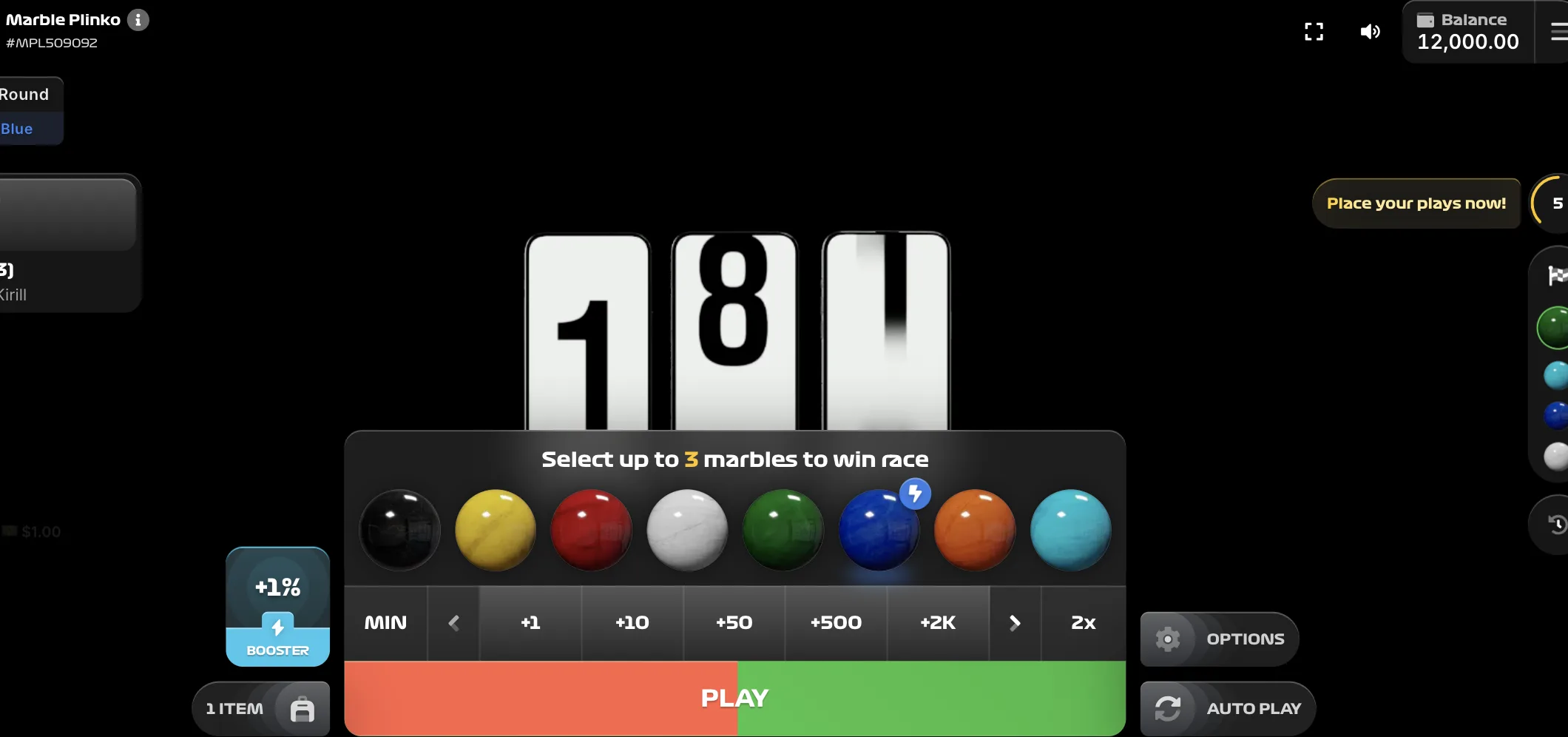
The Marble Plinko betting interface displaying the live marble race, wager options, and session statistics
Before exploring any situational advice, we recommend getting comfortable with the core figures that govern every Marble Plinko round. These are not opinions — they are the fixed parameters built into the game's payout structure, and they apply regardless of which tips you follow.
Return to Player Across Bet Categories
RTP measures the theoretical percentage of wagered money returned to players over an extremely large sample — typically hundreds of thousands of rounds. In Marble Plinko, different bet types produce different RTP values. Here is how they break down on a cumulative wager of €1,000:
| Bet Type | RTP | Expected Return on €1,000 | Expected Loss on €1,000 |
|---|---|---|---|
| Pick Winner | ~93.50% | €935.00 | €65.00 |
| Any Order | ~92.50% | €925.00 | €75.00 |
| Exact Order | ~91.50% | €915.00 | €85.00 |
These long-run averages mask significant short-term swings. In a single session of 50 rounds, your actual results can land well above or well below these figures. That natural fluctuation is what makes gambling feel unpredictable — and what leads some players to mistakenly believe they have found a winning formula after a few lucky sessions.
Calculating the Operator's Margin
The house edge equals 100% minus the RTP. For Marble Plinko, the margins are:
- Pick Winner: 100% − 93.50% = 6.50% house edge
- Any Order: 100% − 92.50% = 7.50% house edge
- Exact Order: 100% − 91.50% = 8.50% house edge
For perspective, blackjack with perfect basic strategy offers a house edge below 1%. European roulette sits at 2.7%. Most crash games operate between 3% and 5%. Marble Plinko's margin exceeds all of these, meaning your balance erodes at a faster rate relative to total wagers placed. Many players accept this trade-off because of the live-streamed physical marble race format, but it is a cost you should factor into every session plan.
Short-Run Swings vs. Long-Run Outcomes
Expected value (EV) tells you what happens on average across tens of thousands of rounds. Variance describes the range of actual outcomes during shorter stretches. Marble Plinko sits at medium volatility, which in practice means:
- You will not experience the extreme droughts and jackpot spikes typical of high-volatility slots
- You will not see the gentle, low-amplitude drifts characteristic of low-variance table games like baccarat
- Within a 50–100 round session, noticeable peaks and valleys are normal, but truly catastrophic swings are infrequent
A concrete example: wagering $1 per round for 50 rounds ($50 total staked) might leave you $10 up or $20 down. Both results fall within expected variance. Across 5,000 rounds at the same stake ($5,000 total wagered), you will almost certainly be down $325–$425 — the house's mathematical share at that volume.
Each Round Stands Alone
Every Marble Plinko round is a fresh physical race. Eight coloured marbles are released simultaneously onto a real plinko peg board, and the order in which they reach the bottom is determined by genuine physics — gravity, peg deflections, and micro-variations in trajectory. The marble that won the previous race has no bearing on the next. If Green has finished first five consecutive times, its probability of winning the following race is unchanged. Our team tracked hundreds of sequential results and found no statistically significant serial correlation — the data confirmed what probability theory predicts.
This matters because the belief that a result is "due" after a streak is the single most expensive misconception in gambling. It drives players to increase stakes after losses, convinced that a correction is imminent. No correction is owed. Marbles bouncing off physical pegs do not balance their finishing positions round by round.
Scenario: Planning Your Session Before You Start
The most important decisions in Marble Plinko happen before you place a single wager. Our team found that players who established clear parameters in advance consistently reported more satisfying experiences and smaller total losses than those who improvised. Here is the pre-session framework we recommend.
Decide Your Budget and Stick to It
Choose an amount you can lose entirely without any financial impact on your daily life. This is your session bankroll — treat it the way you would treat the price of a concert ticket or a night out. Once that money is spent, the entertainment is over.
Select the Right Bet Type for Your Goal
- Longest possible session: Use Pick Winner with up to 3 marble selections. Selecting 3 marbles gives you the highest win probability per round. At ~93.5% RTP and 1% bet sizing, we observed approximately 90–120 rounds of play before a bankroll was depleted by the margin.
- Balance of duration and engagement: Mix Pick Winner with occasional Any Order bets. The slightly higher 7.5% house edge on Any Order trades a small amount of session length for more varied outcomes. Studying each marble's win probability (ranging from 9.5% to 14.10%) adds an analytical dimension.
- Short, high-intensity experience: Exact Order bets target multipliers up to ~26x. Expect shorter sessions and larger swings. We recommend capping these at 10–15 rounds.
Bet Sizing Reference Table
| Session Budget | Max Bet at 1% | Approximate Rounds (Pick Winner) | Estimated Play Time |
|---|---|---|---|
| €50 | €0.50 | ~90–120 rounds | ~80–110 minutes |
| €100 | €1.00 | ~90–120 rounds | ~80–110 minutes |
| €200 | €2.00 | ~90–120 rounds | ~80–110 minutes |
| €500 | €5.00 | ~90–120 rounds | ~80–110 minutes |
The round estimates remain similar across budget sizes because percentage-based staking scales proportionally. At 1% bet sizing with Pick Winner, the house edge removes roughly 0.065% of your bankroll per round (6.5% of the 1% you risk). That produces around 100 rounds of comfortable play before variance compresses your balance toward zero.
Set Time and Loss Boundaries Before Round One
- Time cap: We recommend 60 minutes maximum for standard sessions, 15 minutes for high-risk Exact Order sessions. Set a phone alarm.
- Loss floor: Stop playing after losing 30% of your starting bankroll. Starting at €100 means walking away at €70.
- Profit ceiling: Stop after gaining 50% of your starting amount. Starting at €100 means stopping at €150.
Writing these numbers down on paper — or using the deposit limits and session timers offered by most casino platforms — makes enforcement significantly easier than relying on willpower alone.
Watch a Few Races Before Committing Money
Spend 2–3 rounds as a spectator before wagering. During this warm-up period:
- Watch how the 8 marbles interact with the peg board and note which colours tend to finish near the front
- Familiarise yourself with the ~60-second round cycle and the betting window timing
- Review the displayed win probabilities for each marble (9.5%–14.10%) to understand the odds
- Check whether a Lightning Round or Streak Multiplier is active, as these affect potential payouts
Scenario: You Are Ahead — Locking In Your Gains
Finishing a session with more money than you started with is the exception, not the rule. When it happens, how you respond determines whether those gains survive. Our testing revealed that the overwhelming majority of players who gave back their winnings did so because they abandoned their pre-set exit rules.
The Take-Profit Trigger
If you set a 50% profit target before starting and your €100 bankroll reaches €150, close the session. The temptation to continue — to push that €150 toward €200 — is powerful, but the mathematics have not changed. The house edge on your next bet is identical to what it was on your first. Being ahead does not give you momentum; it simply means variance tilted in your favour temporarily.
Pocket-and-Play Method
If you find a strict exit difficult, try this compromise: when your balance reaches your profit target, mentally divide it. "Pocket" your original bankroll plus half the profit (in this example, €125) and continue playing with the remaining €25. When that €25 is gone, you stop — guaranteed to leave with €125 regardless of what happens next. This approach satisfies the urge to keep playing while protecting the bulk of your gains.
Do Not Escalate Bets When Winning
A common impulse during a hot streak is to increase bet sizes, reasoning that you are playing with "house money." This is a psychological illusion. Every euro in your balance belongs to you — there is no separate category of "house money" that is less painful to lose. Raising your stakes when ahead simply accelerates the rate at which variance can erase your gains. We recommend maintaining your original 1% sizing throughout.
Avoid Upgrading to Riskier Bet Types
Switching from Pick Winner (~93.5% RTP) to Exact Order (~91.5% RTP) while winning trades a 6.5% house edge for an 8.5% one. The wins that built your current balance do not subsidise the increased cost of higher-risk wagers. Stick with the bet type you chose during session planning.
Scenario: You Are Behind — Stopping the Bleeding
Losing sessions will outnumber winning ones over time — that is the mathematical certainty of a negative-EV game. The critical skill is not avoiding losses but controlling their depth. Our team identified the behaviours that transform a manageable loss into a damaging one.
Recognise the Chase Impulse
After a string of losses, most players experience a compelling urge to "win it back." This manifests in predictable ways:
- Doubling or tripling bet sizes to recover faster
- Switching from Pick Winner to Exact Order bets, chasing higher multipliers to close the gap in one round
- Ignoring pre-set loss limits because "one more round" might turn everything around
- Making additional deposits beyond the original session budget
Every one of these behaviours increases your expected losses. The house edge does not care about your session history. A recovery is not statistically more likely after a losing streak — each round remains independent.
The 30% Rule in Action
If your €100 bankroll drops to €70, your session is over. Closing the browser at that point preserves €70 for another day. Continuing to play while emotionally compromised is how €70 becomes €30, then €0, then an unplanned deposit. Our team observed this pattern repeatedly during testing and cannot overstate how common it is.
Practical Steps When Your Balance Is Falling
- Reduce bet size proportionally. If your bankroll has dropped to €80, your 1% ceiling drops to €0.80. Never increase stakes to chase losses.
- Stay with Pick Winner bets. Moving to higher-risk bet types during a losing streak raises the house edge from 6.5% to 8.5%.
- Step away from the screen. A 10-minute break disrupts the emotional spiral. Tilt dissipates when you stop staring at the betting panel.
- Never make a second deposit. Your session budget was set for a reason. Adding funds mid-session is almost always an emotional decision, not a rational one.
Cool-Down Period
After hitting your loss limit, we recommend a minimum 24-hour gap before your next session. This is not arbitrary — it takes time for the emotional response to a losing session to subside. Decisions made in the immediate aftermath of losses are disproportionately likely to be poor ones. Marble Plinko runs around the clock, every day. The game will still be there when you return with a clear head.
Scenario: Making a Small Budget Last
Not every player arrives with a large bankroll, and that is perfectly fine. Marble Plinko can be enjoyed at minimal stakes provided you approach it with discipline. Here is how our team recommends maximising entertainment value on a tight budget.
How the 1% Bet Sizing Rule Protects You
Risking no more than 1% of your current balance per round creates a natural deceleration effect. If you begin with €50 and bet €0.50, then after a loss your balance drops to €49.50 and your next bet becomes €0.495 (rounded to €0.50 on most platforms). After ten consecutive losses at this rate, you have lost approximately 9.6% of your starting balance — a setback, but far from catastrophic.
Compare this to flat 10% betting: the same ten-loss streak at 10% sizing would consume roughly 65% of your bankroll. The difference between comfortable absorption and near-elimination comes entirely down to bet sizing discipline.
Marble Selection Strategy Matters
Each of the 8 coloured marbles in Marble Plinko has a distinct win probability, ranging from 9.5% to 14.10%. These probabilities are determined by the physical design of the plinko board and peg layout. Our team noticed that focusing on higher-probability marbles produced slightly more consistent results, while mixing in lower-probability marbles offered the potential for better payouts. Spend a few rounds studying the probability display before committing your bankroll.
Single vs Multi-Marble Selection
Pick Winner allows you to select up to 3 marbles per race. Selecting a single marble with the highest win probability targets a higher multiplier but lower hit rate. Selecting 3 marbles increases your chance of winning each round but reduces the payout multiplier. Our team found that a 2-marble selection offers a practical middle ground for budget-conscious players, balancing frequency of wins against payout size.
When in Doubt, Skip a Round
One of the simplest bankroll-saving tips is also the most overlooked: you do not have to bet every round. Marble Plinko streams 24/7 from the 155.io studio, so there is always another race starting within 60 seconds. If you are uncertain about your selection or feeling impulsive, sitting out costs you nothing and preserves your balance for rounds where you feel more confident.
Use Platform Tools for Self-Regulation
Most casino platforms offering Marble Plinko provide built-in responsible gambling features: deposit caps, session timers, loss limits, and cooling-off periods. Activate these before your first round. They function as external guardrails that enforce your pre-session decisions even when your in-the-moment judgement wavers. There is no downside to using them.
Why Doubling Down and Other Staking Systems Always Collapse
Online forums are filled with claims about betting systems that "guarantee" profits in Marble Plinko. Our team evaluated the most popular ones and confirmed what probability theory predicts: none of them work. Here is the evidence.
The Martingale Breakdown — Round by Round
The Martingale system instructs you to double your bet after every loss, so that the first win recovers all previous losses plus a profit. Starting at $1 with Exact Order bets:
| Round | Bet Amount | Total Invested | Win at 18x Pays | Net Profit if Win |
|---|---|---|---|---|
| 1 | $1 | $1 | $18 | +$17 |
| 2 | $2 | $3 | $36 | +$33 |
| 3 | $4 | $7 | $72 | +$65 |
| 4 | $8 | $15 | $144 | +$129 |
| 5 | $16 | $31 | $288 | +$257 |
| 6 | $32 | $63 | $576 | +$513 |
| 7 | $64 | $127 | $1,152 | +$1,025 |
| 8 | $128 | $255 | $2,304 | +$2,049 |
| 9 | $256 | $511 | $4,608 | +$4,097 |
| 10 | $512 | $1,023 | $9,216 | +$8,193 |
At round 10, a single wager costs $512 and your cumulative expenditure stands at $1,023. Most platforms impose maximum bet limits well before this point. More critically, with a per-round win probability near 5.5% on Exact Order, the chance of losing all 10 rounds is roughly 56%. That means more than half of all Martingale sequences reaching 10 rounds will result in a total wipeout.
The Martingale does not alter your expected value. It restructures your outcomes into frequent small gains and occasional devastating losses. Over enough attempts, those devastating losses appear and erase every accumulated gain. This is a mathematical certainty, not a matter of luck or timing.
Other Systems Share the Same Flaw
Fibonacci, D'Alembert, Labouchere, and every other progressive staking method share a fundamental deficiency: they change the size and pattern of bets without changing the expected value. If the house edge on a single $1 wager is $0.065, then the expected loss across 100 bets totalling $1,000 in stakes is $65 — regardless of whether those bets were $1 each, or an escalating sequence of varying sizes. The aggregate expected loss always equals the house edge multiplied by total amount wagered.
Progressive systems appear to work because they produce many small winning sessions and rare large losing ones. Over a short sample, you may only encounter the winning sessions and conclude the system is effective. But the large losses are inevitable given enough time, and they cancel out all prior gains.
The "Bigger Bets, Better Returns" Misconception
Some players believe that increasing their stake size improves their RTP. In Marble Plinko, this is false. A $0.50 Pick Winner wager carries exactly the same 93.5% RTP as a $500 Pick Winner wager. Larger bets increase the absolute amounts won or lost but do not shift the percentage retained by the operator. Unlike certain slot games where higher denominations occasionally unlock better payout schedules, Marble Plinko's margin is uniform across all stake levels.
Low, Medium, and High Risk — Which Approach Fits Your Goals?
After testing each approach extensively, our team compiled this summary to help you match your playing style with the right bet type and session structure.
| Approach | Risk Level | Best Bet Type | RTP | Typical Session | Suited For |
|---|---|---|---|---|---|
| Budget-Conscious | Low | Pick Winner | ~93.5% | 60–90 minutes | Maximum play time, controlled spending |
| Informed Observer | Medium | Any Order | ~92.5% | 30–60 minutes | Players who enjoy research and pattern analysis |
| High-Stakes Sprint | High | Exact Order | ~91.5% | 10–15 minutes | Brief sessions targeting higher multipliers |
No approach is inherently "better" — each makes different trade-offs. The budget-conscious path yields the longest sessions and the slowest bankroll decline. The high-stakes sprint opens the door to the largest payouts but burns through funds quickly. The informed observer sits in the middle and adds an analytical dimension that many players find engaging, even if the practical edge over random selection is modest.
You can also combine approaches within a session. A hybrid we found effective during testing: allocate 80% of wagers to Pick Winner for steady base play, and reserve 20% for occasional Any Order or Exact Order bets when conditions feel favourable. This blends the consistency of low-risk betting with periodic shots at higher multipliers — provided your total staking remains within your bankroll management parameters.
Your Marble Plinko Questions, Answered Honestly
No system can overcome the built-in house edge of 6.5–8.5%. The mathematics apply uniformly to every wager regardless of staking pattern. Tips and strategies exist to manage how rapidly you spend your bankroll, not to generate guaranteed income. Any person or website claiming otherwise is providing misleading information. Our team tested multiple progressive systems across hundreds of sessions and confirmed that long-run results always converge on the expected loss determined by the house edge.
Pick Winner carries the lowest house edge at approximately 6.5%, translating to an RTP of around 93.5%. For every €100 wagered on Pick Winner bets, the expected return is €93.50 on average. By comparison, Exact Order bets retain only about €91.50 per €100 wagered. If your primary objective is stretching your bankroll as far as possible, Pick Winner is the mathematically optimal choice.
The Martingale doubling approach collapses for three interconnected reasons: platform bet limits prevent the indefinite escalation required for the system to function, real-world bankrolls cannot sustain the exponential growth in stake sizes during cold streaks, and the house edge applies to every bet regardless of how large it becomes. Starting at $1 and doubling after each loss, you would need $1,024 for your bet at round 11 — with over $1,000 already invested. Using Exact Order bets, losing streaks of 10 rounds occur in more than half of all attempts. The system does not change expected value; it merely concentrates your losses into rare but devastating episodes.
We recommend bringing only money you can lose entirely without financial stress. Using 1% bet sizing on a $100 budget with Pick Winner bets, expect approximately 90–120 rounds of play — roughly 80–110 minutes. That translates to an average entertainment cost of about $6.50 per hour, which is competitive with many leisure activities. The key principle: your session bankroll should be an amount whose complete loss causes you zero financial hardship. If losing the amount would affect your ability to pay bills, eat, or meet other obligations, it is too much.
Spending 2–3 rounds as a spectator helps you understand how the marbles interact with the plinko board and which colours tend to finish near the front. Studying the displayed win probabilities (9.5%–14.10% per marble) gives you useful context for your selections. However, each ~60-second race involves genuine physical randomness as marbles bounce off metal pegs, so watching previous races cannot create a statistically meaningful edge. Our testing confirmed that informed marble selections only marginally outperformed random picks — not nearly enough to offset the 6.5–8.5% house edge. Consider observation a way to make more thoughtful bets rather than a reliable prediction technique.
Marble Plinko's RTP of 91.5–93.5% is comparable to many mid-range slots and noticeably lower than most crash games (typically 95–97% RTP). Blackjack with perfect strategy delivers over 99% RTP, and European roulette provides 97.3%. Marble Plinko's distinctive appeal is the live-streamed physical marble race on a real plinko board — no RNG, just genuine physics — which many players find more transparent and engaging than algorithm-generated outcomes. Whether the entertainment value justifies the higher mathematical cost is a personal decision that depends on your preferences and how you define value in a gambling product.
Each of the 8 coloured marbles has a different win probability, ranging from 9.5% to 14.10%. These probabilities are determined by the physical layout of the plinko peg board and are displayed before each race. Selecting marbles with higher win probabilities can marginally improve your expected results over many rounds. However, because each race involves genuine physics — marbles bouncing off real metal pegs — individual outcomes remain unpredictable regardless of probability data. Our team tracked results across hundreds of races and found that probability-informed selection helps calibrate general expectations but does not provide a consistent statistical edge over the 6.5–8.5% house margin. The operator's advantage applies equally to all marble selections.
Continue Exploring Our Marble Plinko Guides
Dive deeper into specific aspects of the game with these companion resources from our editorial team:
Complete walkthrough of Marble Plinko's three bet types, round structure, multiplier tiers, and payout tables. The essential primer for anyone new to the game.
Read the RulesTest your predictions using virtual credits with no deposit required. An ideal sandbox for applying the tips in this guide before committing real money.
Try Practice ModeCompare welcome deals, cashback promotions, and free bet offers from vetted Marble Plinko casino partners. Updated monthly with current promotions.
View OffersUse our exclusive code at sign-up to access enhanced welcome packages at partner casinos, including deposit matches of up to 500%.
Get Bonus CodeInstall Marble Plinko on your device. Covers Android APK installation, iOS PWA configuration, and desktop browser optimisation for the best experience.
Mobile GuideStep-by-step account registration at leading Marble Plinko platforms. Includes KYC verification tips, deposit options, and first-session recommendations.
Sign-Up GuideOur comprehensive independent assessment covering RTP analysis, streaming quality, casino partner evaluations, and an honest final verdict with team scores.
Read Full ReviewMeet the analysts behind every strategy guide, RTP calculation, and casino evaluation on this site. Full methodology, testing criteria, and affiliate disclosure.
Meet the Team